Why Are There So Many Cafes in South Korea?

A three-story Starbucks. A tiny local roastery with a narrow staircase leading up to a room full of people on laptops. Hollys next door, Coffee Bean across the street. Walk anywhere in Seoul and another cafe shows up every few minutes. In most countries, cafes cluster where people commute, work, and meet, built for a quick drink or a short break during lunch. Seoul has that too, but something else is happening: these cafes don’t move you along.
Korean cafes are not built around a quick stop. They are built around staying: friends catching up, couples on dates, students studying, someone wanting a quiet hour alone after work. That is what is visible. The reasons run deeper.

Education
Korean youth aged 15 to 24 study an average of 49.4 hours a week, against an OECD average of 33.9. On a weekday that is roughly seven hours and fifty minutes, compared to five hours across the rest of the OECD. Most of that extra time happens after school ends, not during it: at 야자 (ya-ja), supervised evening study sessions held at school, or at 학원 (hagwon), private academies that run subjects ahead of the regular curriculum. More than 95 percent of middle schoolers attend at least one hagwon. Many students are picked up by parents past eleven at night, and the cycle repeats the next weekday.
There is very little room left in that schedule for anything that is not being watched or graded. Home does not fix this. Parents are in the next room, and the pressure that built the schedule in the first place is still there. The cafe offers something home does not: a boundary. No one knows your grades. No one is watching. You can sit for two hours with a single Americano and no one asks you to do anything. It is not just coffee. It is space.
Architecture
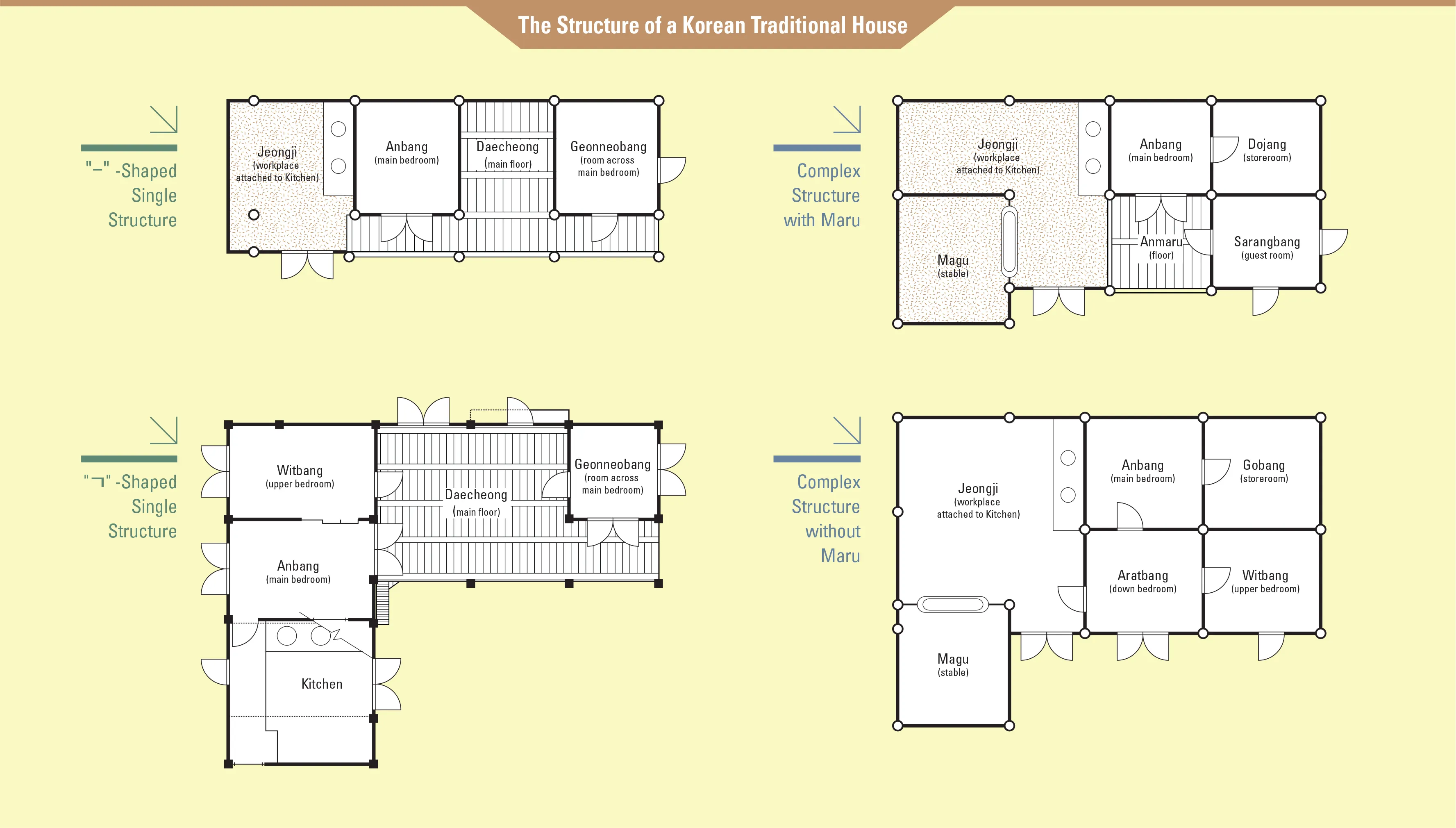
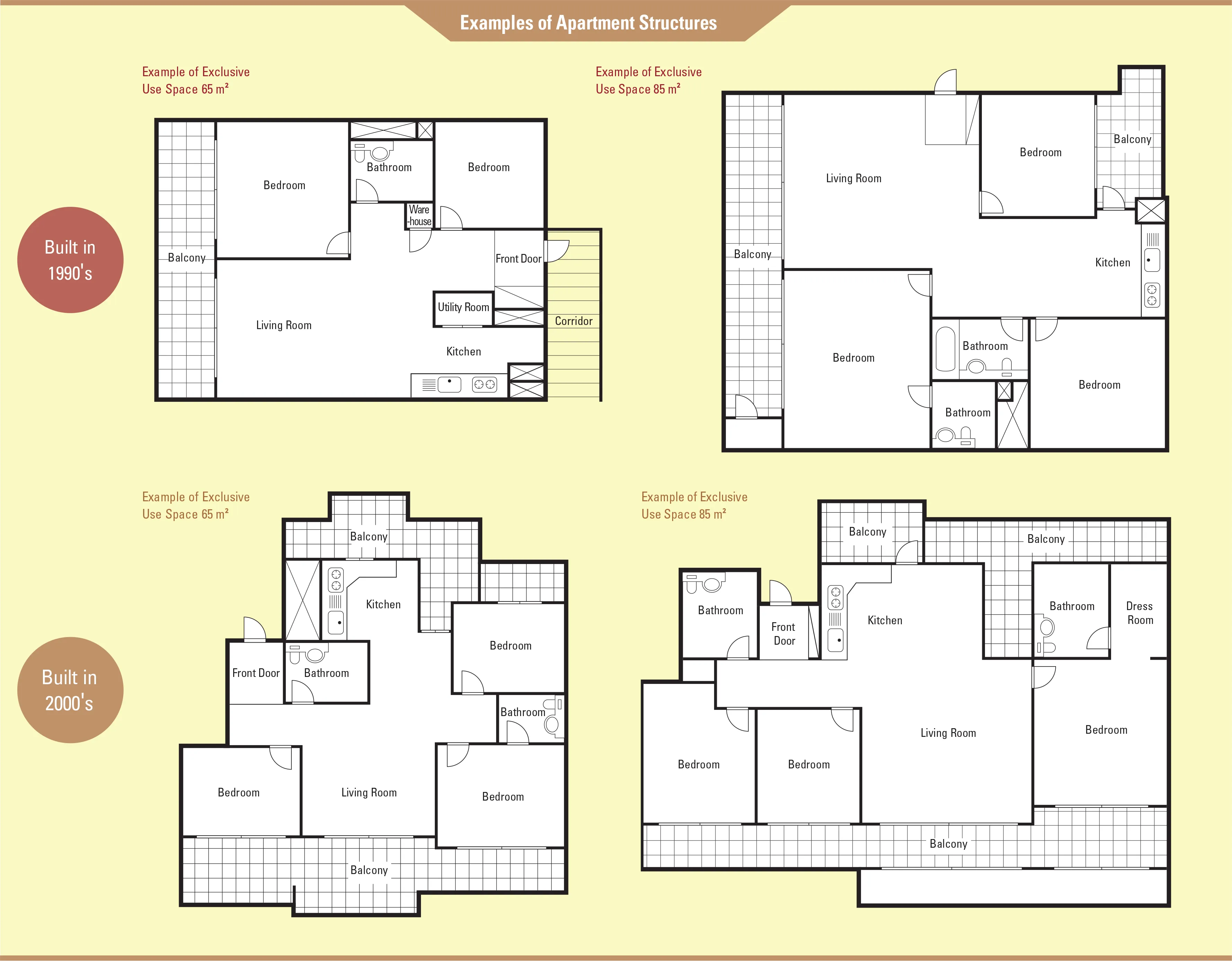
Traditional Korean housing, the hanok, was built around a central shared space. Depending on the house type, this took the form of an open courtyard called a 마당 (madang), or a raised wooden-floored hall known as 대청마루 (daecheong maru). Every room opened directly onto it. Step out of your room and you could see across to the rooms on the other side. Interaction was built into the structure.
Modern Korean apartments have a 거실 (living room), a shared central space that echoes the same idea, but the layout works differently. Each bedroom faces outward, and the door faces a hallway, not the other rooms. Close your door and the visibility that used to run through the house is gone. Koreans have a word for the result, 대화단절, a breakdown in household conversation, and this shift in floor plan is one reason it gets named as a cause.
Most Korean apartment towers use 계단식 구조, a stairwell layout where each unit sits directly above and below the next, sharing almost no wall with its side neighbors. That solves one noise problem and creates another. Nearly 98 percent of apartments built in Korea since the 2000s use 벽식 구조, load-bearing concrete walls instead of a beam-and-column frame. Walls transmit impact noise efficiently and there is no structural buffer between floors, so a footstep or a dropped object on the floor above arrives downstairs as sound, not vibration absorbed somewhere in between. That is 층간소음, floor noise, and it is a constant source of neighbor disputes serious enough that Korea has a government mediation center dedicated to it. Studying at home while noise comes through the ceiling is not a minor annoyance in a country where a single exam can decide which university you get into. The cafe provides acoustic cover the apartment cannot.
Business
Seoul has roughly 90,000 coffee shops for a city of about 9.6 million people, more specialty coffee shops per capita than any other city in the world, and more than double the total number of Starbucks locations in the entire United States. That density did not happen because Koreans wanted more coffee. It happened because two other kinds of demand, students and adults, both needed somewhere to sit for hours, and a cafe that turns tables quickly cannot capture either one. Once a business is built to hold people instead of moving them through, one floor is not enough. So you build up.
Students needed a place with no supervision. Apartments could not offer quiet. Cafes solved both problems at once, and a market that large does not stay small. The three-story Starbucks is not a trend. It is what happens when an entire country needs somewhere to sit that is not home and not school.
References
- Korean youth study hours vs. OECD average, hagwon attendance: The Korea Herald, OECD Education at a Glance 2025
- 벽식 구조 and 층간소음 mechanism, share of apartments built with wall-bearing structure: 나무위키
- Seoul cafe count and per-capita coffee shop density: Seoul Signal
- Image sources of traditional and modern Korean house from top-view: National Atlas of Korea