
Why Some Subway Seats in Korea Have Different Colors — And Why Nobody Sits There
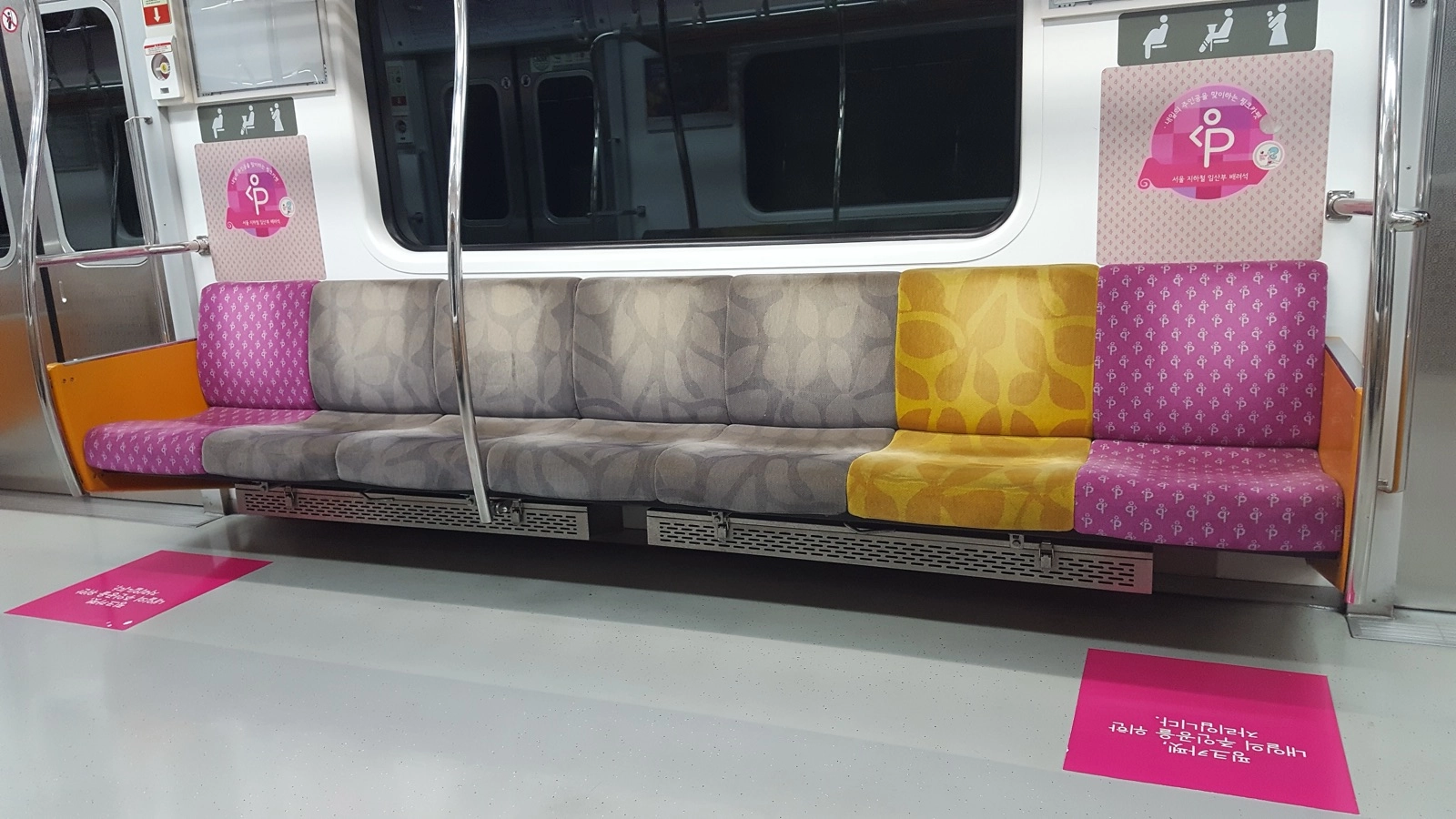
Get on the Seoul Metro during rush hour and you will notice something that does not make sense at first. The car is packed. People are standing in the aisle, gripping the overhead bars, pressed against each other. And at the end of the car, there are empty seats.
They are a different color from the rest. The standard seats are navy or gray. These ones are yellow. On some lines there are also pink ones, set apart in the middle of the car. Both types sit empty while the train is full.
A traveler from a country with a long history of racial segregation might read it that way at first. Color-coded seating. Certain sections held visibly apart. The pattern looks familiar. But look at who is avoiding the seats: everyone. Korean students, Korean office workers, Korean elderly passengers who could use a seat. Whatever is happening here, it is not about who you are.
Nobody sits there. Not standing passengers who have been on their feet since the previous stop. Not teenagers with bags on their laps. Not tourists who have not figured it out yet, though they do sometimes sit there, and then notice something in the body language of the people around them, and stand back up.
The seats are not broken. No one is coming to claim them.
That is what is visible. The reasons run deeper.

Priority Seats
The yellow seats are called 교통약자석 (gyotong yagja seok), which translates to “transportation vulnerable person seat.” They are designated for the elderly, people with disabilities, passengers with infants, and anyone whose physical condition makes standing difficult.
Korea introduced reserved seating on public transit in August 1980, when Seoul placed three seats at each end of subway cars and marked them for elderly and disabled passengers. That system stayed mostly informal for decades. In 2005, transit operators renamed the seats from 노약자석 (elderly/disabled seat) to 교통약자석, broadening the designation and standardizing the yellow color across lines to make the seats immediately identifiable.
The same yellow designation applies on city buses. The seats sit at the front of the bus, closest to the door. Same color, same social rules.
Today roughly 30 percent of all seats on a Seoul subway car are 교통약자석. That is not a small corner of the train. It is a substantial portion of the car that the social contract holds open.
Pregnant Women’s Seats
The pink seats are a separate category introduced around 2013. They are called 임산부 배려석 (imsan-bu baeryeo seok), pregnant women’s consideration seat.
Their existence is the result of a specific conflict. Before 2013, pregnant women sometimes sat in the yellow 교통약자석 when no elderly passengers needed it. That was technically within the purpose of the seat. But it led to confrontations. Elderly passengers would board and ask pregnant women to move, often not knowing or not accepting that pregnancy is also a qualifying condition. The situations became uncomfortable enough that transit authorities created a separate category in 2013, so that pregnant women would have a seat that was unambiguously theirs. The seats were marked pink starting in 2015.
The pink seats now sit in a different position in the car from the yellow ones. They are also almost always empty, including in the middle of the afternoon when the car is mostly full of people who could easily sit. The expectation has transferred fully. Even without a sign telling you not to sit, most Koreans already know.
Reading the Room
Neither seat type carries a legal penalty for misuse. There is no fine. No transit official checks who is sitting where. The enforcement is entirely social.
This is where 눈치 (nunchi) becomes relevant. Nunchi is the ability to read a room: to sense what is expected without being told, and to act accordingly. It operates constantly in Korean public life. Getting on a crowded subway, assessing the situation, and choosing not to sit in a yellow seat when you are a healthy adult in your twenties is a basic expression of nunchi. Sitting there anyway is not just inconsiderate. It signals that you do not understand, or do not care about, the social contract you are part of.
The consequence is not a fine. It is the quiet judgment of everyone around you, and in Korea, that carries weight.
The empty seat at the end of the car is not wasted space. It is held open by a shared understanding that nobody had to write down. Korea built it into the infrastructure in 1980, color-coded it over the following decades, and enforced it through social pressure rather than law. The seat is empty because everyone on the train already agreed it should be.
References
- Priority seat history and social rules: https://en.wikipedia.org/wiki/Priority_seat
- Pink seat introduction after elderly-pregnant conflict: http://koreabizwire.com/controversy-over-subway-seats-reserved-for-pregnant-women-rekindled/186618
- Korean transit etiquette overview: https://english.visitseoul.net/editorspicks/Public-Transportation-Etiquette-in-Korea/ENN031267
- 교통약자석 history (Korean): https://namu.wiki/w/%EA%B5%90%ED%86%B5%EC%95%BD%EC%9E%90%EC%84%9D